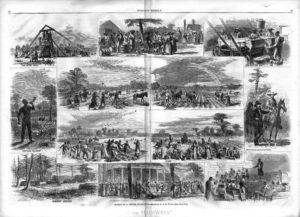
Postbellum America would become a new nation and in short order become the predominant global economy. Just as the fight over constitutionalism, slavery and expansion began to brew in the early to mid-nineteenth century, a tandem event took place, namely the American industrial revolution. Economically speaking, few if any commodities defined American exports, production or manufacturing like cotton. After manufacturing pioneer Eli Whitney created and patented the cotton gin, which was a machine that removed seeds from cotton fiber, the American economy uniquely positioned to capitalize on the industry, exploded onto the world scene.
Normally, in the continuum of classical economics, this should have created not only an enormous export economy towards textiles, but a springboard of economic wealth distribution for the young nation. This would not be the case upon the latter, as slavery was the primary driver in the farming of cotton in the United States, at the time, which would enrich a handful of planters in the South and elite manufacturers in the North and impoverish thousands of yeoman farming families in the process. In turn this created a working underclass in the North and a vast subsistence farming class in the South.
As tensions and tempers flared, a civil war drew nigh and in 1860 many Southern states would succeed from the Union, which spawned a bloody and grueling war between countrymen, women and children. The end of legal slavery would be the outcome of the war, with a South that was razed to the ground and forced to comply with the outcome. In this sense, especially with the outlawing of free labor and chattel slavery, combined with massive crop destruction, it would seem logical that the American cotton industry would fade away with the Confederacy. This did not happen; indeed, the inverse took place, and the cotton industry was about to not only remain a primary powerhouse for the American economy, but would soar to new heights, with slavery and free labor in the rearview.
The numbers do not lie, as classical economists were quickly proven correct that slavery was not only immoral, but an economic failure. After 1865 cotton was produced through wage labor by sharecroppers, small farmers and plantation owners, both black and white. By 1870 the South had produced more cotton in 1860 and by 1880 cotton exports were higher than in 1860. Cotton production in the state of Georgia alone increased by over 47% between 1860 and 1880, which is a strong indicator as to the economic faltering of the institution of slavery. More Southern farmers switched to cotton production after emancipation, displacing food production of crops such as grain and corn, which shifted to the mid-Western states. Specialization now relied upon ingenuity, technology and sound investing, rather than family states and slave labor. This again revealed the power of free enterprise, as cotton production and sales soared during and after Reconstruction.
Another sector of the country would now take its seat at the table, as the West was now more than “free soil” territories, but now becoming Unionized states without slavery all together. The same railroads that revolutionized the nation North to South, connected the Pacific Coast to the Atlantic Coast, which was a further boost for the cotton industry after about 1870 onward. Regardless of pests, storms, speculation or political and social fights, cotton continued to be a leading economic driver for the United States. Harper’s Weekly reports in an 1878 financial outlook that “the Agricultural Bureau and on the New York and New Orleans exchanges the cotton crop is estimated to as being more likely to exceed than to fall short of four million bales.” King Cotton was no longer a euphemistic tool of the Confederate South, but a legitimate quasi free enterprise that would quite literally pull the country out of ruin and debt, holding the foreground in exports and profits making the United States the global leader in cotton until 1937.
As the nation expanded Westward, cotton came along. The hot and dry climate, matched with the harder soil should have left King Cotton East of the Mississippi River, yet ingenuity, a little luck combined with massive irrigation and federal subsidies, cotton would soar even higher in price, exports and wealth creation. By 1920 cotton became an enormous agribusiness in the West, with ex-Georgians like J.G. Boswell at the helm in the Central Valley of California. In 1960 the Boswell family became the largest single farmer in the nation owning millions of acres, almost solely producing cotton, in an arid semi-desert region, incurring some of the largest irrigation projects ever recorded.
Cotton production and manufacturing were with Americans in the early days and turned large profits, yet this came at the hands of enslaved humans and did not enrich the nation collectively, nor did it enhance the soul of a proclaimed constitutional republic. Every step of the way, the voices of the abolitionists and the classical economists could be heard denouncing the institution of slavery in America but were not immediately heeded. Once slavery was ended, the American economy rocketed almost overnight, growing exponentially for over a century, and cotton played a significant role in total economic growth and gross domestic product. Unfortunately, finance capitalism would become instituted in the twentieth century incurring inflation, market crashes and unfathomable indebtedness and if one listens closely, you can still hear the abolitionists and classical economists pleading with the nation.
Sources
- Arax, Mark. The King of California: J.G. Boswell and the Making of a Secret American Empire. New York: Public Affairs, 2003.
- Dattel, Eugene R. “Cotton and the Civil War.” Mississippi History Now. July 2008. http://mshistorynow.mdah.state.ms.us/articles/291/cotton-and-the-civil-war (accessed July 6, 2021).
- Harper’s Weekly. “Harp Week: Explore History.” Agricultural machinery and equipment. December 18, 1869. https://app-harpweek-com.ezproxy.liberty.edu/ViewIndexEntryLightbox.asp?SubEntryClass=Illustration&SubEntryKey=032622&MainEntryKey=000336 (accessed July 6, 2021).
- Harper’s Weekly. “Harp Week: Explore History.” American South, business and economy. September 27, 1878. https://app-harpweek-com.ezproxy.liberty.edu/ViewIndexEntryImage.asp?subEntryClass=Combined&subEntryKey=685628&page=1&imageSize=d (accessed July 6, 2021).
- Weiman, David F. “The Economic Emancipation of the Non-Slaveholding Class: Upcountry Farmers in the Georgia Cotton Economy.” The Journal of Economic History 1, no. 45 (1985): 71-93.

israelnightclub says:
Itís difficult to find experienced people in this particular topic, but you seem like you know what youíre talking about! Thanks
נערות ליווי באשקלון says:
Good day! I just want to offer you a big thumbs up for your excellent information you have got here on this post. Ill be coming back to your blog for more soon.